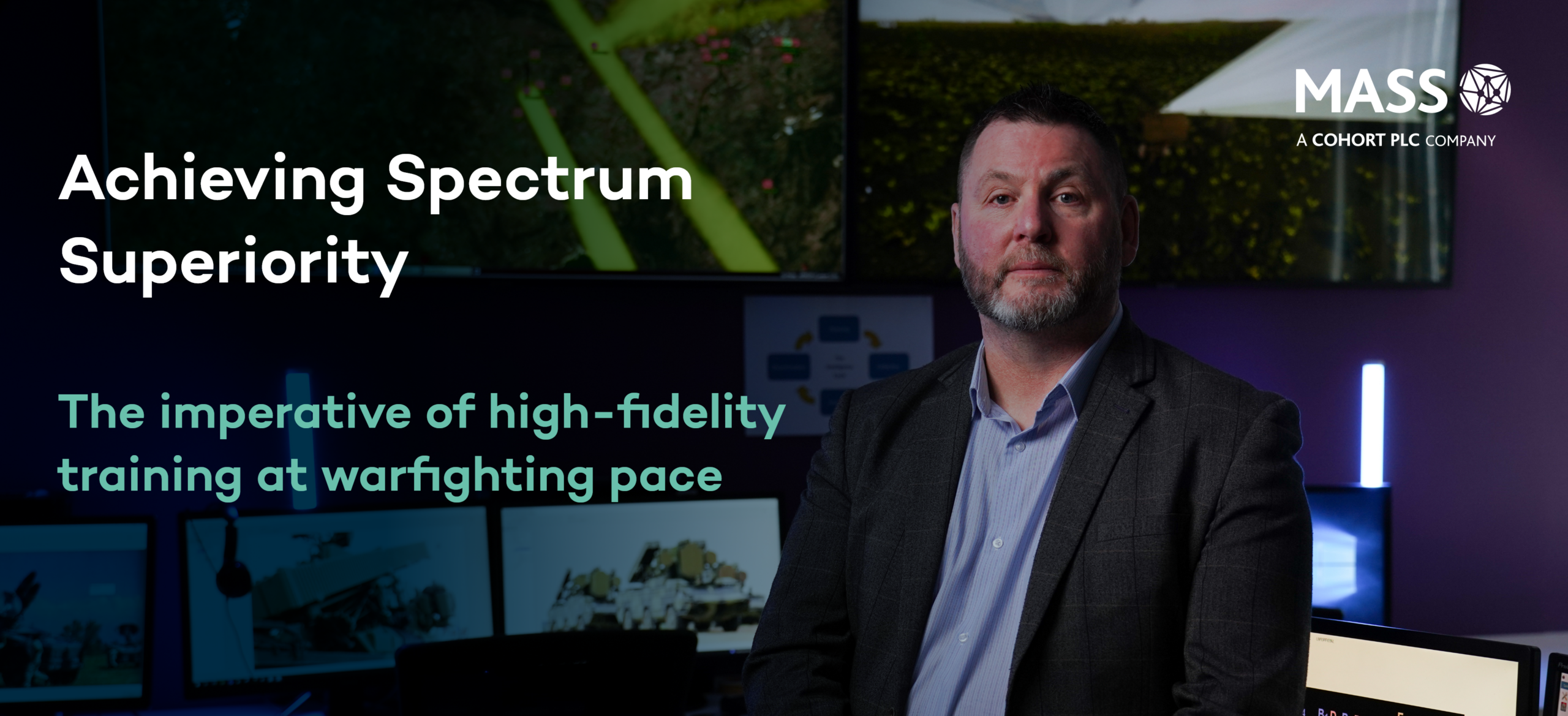
As the global defence community gathers for AOC Europe 2026 later this month, the conversation has shifted from hardware parity to “Spectrum Superiority”. In an era defined by multi-domain operations and peer-level competition, dominance in the electromagnetic spectrum (EMS) is no longer a luxury, it is the foundation for all other mission successes. However, achieving this superiority requires more than advanced sensors; it demands a fundamental evolution in how we train operators of Electronic Warfare (EW) and Cyber Electromagnetic Activities (CEMA).
To secure the spectrum, we must bridge the gap between intelligence validation and operator proficiency.
The velocity of the modern threat
The primary challenge of modern spectrum warfare is the sheer velocity of mission data evolution. In a high-tempo peer conflict, Signal of Interest (SOI) libraries are modified and supplemented at a rate that far outstrips traditional, linear training cycles. Historically, training has been hampered by static, pre-configured scenarios – an approach that inadvertently prepares operators for past conflicts rather than the evolving present.
True spectrum superiority is maintained only when training keeps pace with warfighting pace. This requires a live training variable mindset. We must move toward a battle rhythm where threat library updates flow into simulation and emulation phases within days, not months.
Through our SESCO™ model, this agility is finally achievable. By utilising our Training Simulator, NEWTS IQ, to emulate IQ data via scenario-based files superimposed on real-world spectrum, we can integrate updated threat waveforms into the training environment almost instantly. This ensures that the operator’s mental model of the battlefield remains synchronised with the reality of the electromagnetic environment (EME).
Fidelity as a strategic asset
A commander’s trust in their electronic warfare team depends heavily on how realistic their training has been. For a long time, training has relied on simplified signal data that strips away much of the real-world complexity. That approach works for learning the basics, but it no longer meets the realities operators will face today’s highly contested and congested battlespace.
Modern peer-adversary systems are engineered specifically to exploit the gaps left by legacy training. They utilise sophisticated signal tricks, phase agility, and deliberate anomalies to frustrate detection.
The strategic question for leadership is no longer “Is the team trained?” but rather, “Is the team trained against the signals designed to deceive them?”
By transitioning to high-fidelity IQ signals, we provide operators with the full character of the threat. NEWTS IQ allows for training against what the adversary actually radiates; noise, deception, and everything in between. This level of immersion ensures that when an operator encounters a deceptive waveform under operational stress, it is a recognised entity rather than a fatal surprise.
Defining readiness at AOC Europe 2026
As we look toward the future of defence, we must acknowledge that spectrum superiority is a perishable advantage. It is won or lost in the days and weeks prior to engagement, rooted in the currency of our mission data and the fidelity of our training signals.
The path forward requires a commitment to dynamic readiness. By treating mission data as a live variable and prioritising high-fidelity IQ emulation, we ensure that our EW and CEMA forces are not merely reactive, but dominant. In the contest for the spectrum, the fastest loop wins: from academy, to simulator, to the edge.